
The untapped potential for better waste and resource management to curb global heating
I am pleased that the RICS Land Journal has published online an updated version of my article on the untapped potential for the waste and resource management sector to act as an enabler to unlock significant climate mitigation benefits across the economy. My best estimate of the mitigation potential is at least 15-20% of global carbon dioxide (equivalent) emissions, which is far beyond the IPCC’s estimate of 3% for the narrowly defined end-of-the linear-economy ‘waste’ sector, which is necessarily used in official climate reporting to avoid double counting.
CIWM success in influencing policy
DCW’s Presidential year at CIWM continues to be dominated by marine plastics. As part of our efforts to influence developing UK policy in this area, CIWM and Wasteaid published a report: ‘FROM THE LAND TO THE SEA: How better solid waste management can improve the lives of the world’s poorest and halve the quantity of plastic entering the oceans’. His June CIWM column reports success: the day before the biennial Commonwealth Heads of Government Meeting in London in April, Theresa May announced a new Commonwealth Clean Oceans Alliance (CCOA) backed by a £61.4 million funding package of funding to help tackle marine plastics, of which more than £20 million would help developing country members of the CCOA improve waste management at a national and city level.
Revaluing Recycling
Europe and North America have a problem with sustainable recycling. China’s ban on imports has thrown the problem into sharp focus: where are the markets for the materials we are collecting for recycling to meet the targets? And how do local authorities balance their already curtailed budgets as prices for recycled materials plummet? DCW’s May CIWM column explores the history of recycling over the last 40 years, and concludes that our existing policy support measures, focusing on increasing supply rather than demand, are not fit for purpose. He argues that we need to rethink recycling to make it a sustainable foundation for our future circular economy; and makes the case for considering explicitly the embodied social, environmental and technical values alongside the market price.
Uncontrolled burning of solid waste as a significant contributor to climate change
To qualify for inclusion in the official (IPCC) inventory of greenhouse gases (GHGs), data for an emission source must meet a quality threshold. This currently excludes black carbon emissions from the open burning of wastes. The relative quantities may be small compared to carbon dioxide from fossil fuels or methane from landfill, but black carbon is around 2,000 more powerful than CO₂ as a GHG. In the absence of real data, early modelling studies using broad assumptions suggested that black carbon from open burning contributes 5% of total global GHG emissions, causing 270,000 premature deaths a year. DCW’s PhD student at Imperial College London, Natalia Reyna, has been working for the last four years to provide real data which would meet the IPCC requirements. Our first paper, published this month in the leading journal Environmental Research, presents field data from Mexico on how much solid wastes are disposed of by open burning, either by households or at uncontrolled dumpsites. The results suggest a GHG contribution from uncontrolled burning in backyards in Mexico fifteen times larger compared to methane released from the decomposition of equivalent amounts of waste in a disposal site. A future paper will present data on emission factors, i.e. how much black carbon is produced by burning a kilogram of waste.
China: Coming Full Circle
China’s recent import ban has thrown Western recycling systems into disarray. DCW has participated as CIWM President in three regional open meetings to address the ‘China recycling crisis’. His April column for the CIWM Journal has written up his presentation, providing a personal perspective on how he has seen China’s internal resource and waste management systems develop over the last 40 years. Arguably, its 1970s system could be viewed as an early example of a circular economy. The transition to ‘market -oriented’ operations led to economic growth being prioritised over environmental protection. But the current ‘National Sword’ campaign is just one symptom of a fundamental change, suggesting that, going forward, perhaps China really could lead the world in transitioning to a circular economy.
Let’s Skip ‘The Tip’
Language matters. DCW’s March column for the CIWM Journal celebrates the dramatic improvements in waste and resource management that have been achieved since he first entered the sector in 1974. This is largely due to changes in public behaviour, which have enabled the UK, for example, to increase recycling rates over the last 20 years from just 6% to 46%. However, he questions how we can expect people’s mind set to change permanently when some local authorities, and both professionals and politicians, continue to refer to modern recycling facilities as ‘the rubbish tip’.
Turning the Tide
DCW’s February column for the CIWM Journal focused on the topical subject of marine plastics. He reported back on ‘Oceans 21’, the latest Development Finance Forum organised by the German Development Bank KfW, where he led a workshop on marine litter. The conclusions were clear: the amount of plastics entering the oceans is at least an order of magnitude greater than estimates of the visible quantities in the oceans or on beaches – so the first priority is to ‘turn off the tap’. And the most effective way to do that is to extend municipal solid waste collection in developing countries to all people and to eliminate uncontrolled dumping and burning; our best judgement was that this could reduce the weight of plastics entering the oceans by 50-70%.

DCW wins 2024 ISWA Publication Award
DCW won the 2024 ISWA Publication Award for his magnum opus, looking back over his long career at the evolution of waste and resource management since the first environmental control legislation in the 1970s, and reflecting on current and future priorities.
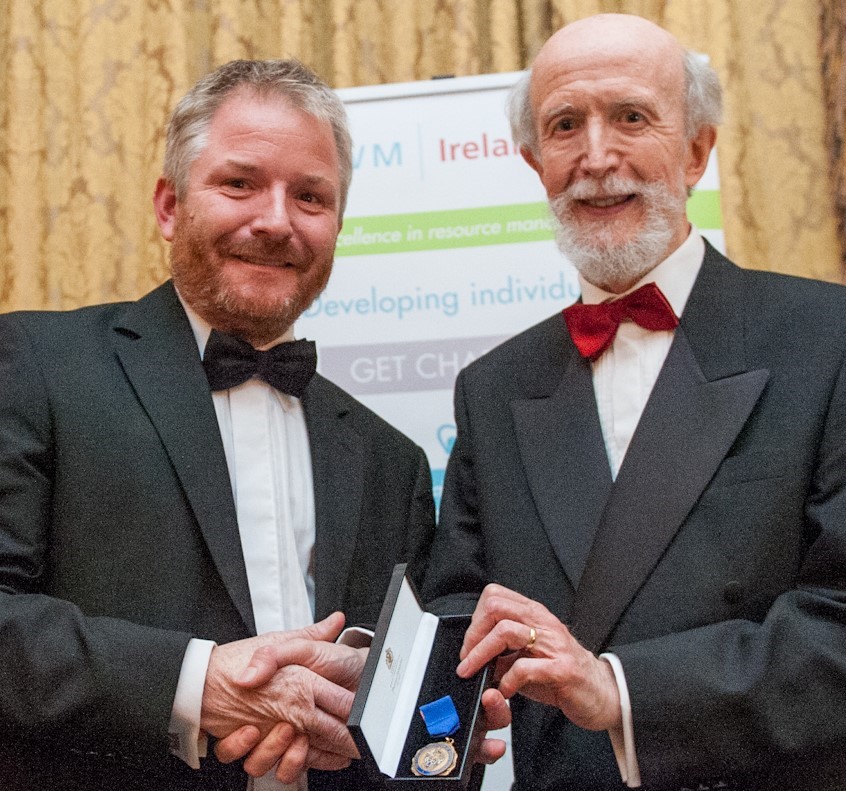
DCW awards his Presidential Medal
DCW awarded his CIWM Presidential Medal for 2018 to Mike Webster, the founder and CEO of the new charity Wasteaid, which is working directly with local communities to tackle the global waste crisis.

DCW hands over CIWM Presidency
DCW handed over to Enda Kiernan at the Aviva Stadium in Dublin on 13th November 2018. The Gaelic Football team which Enda manages appeared in the lead photo story of the previous day’s Irish Times.
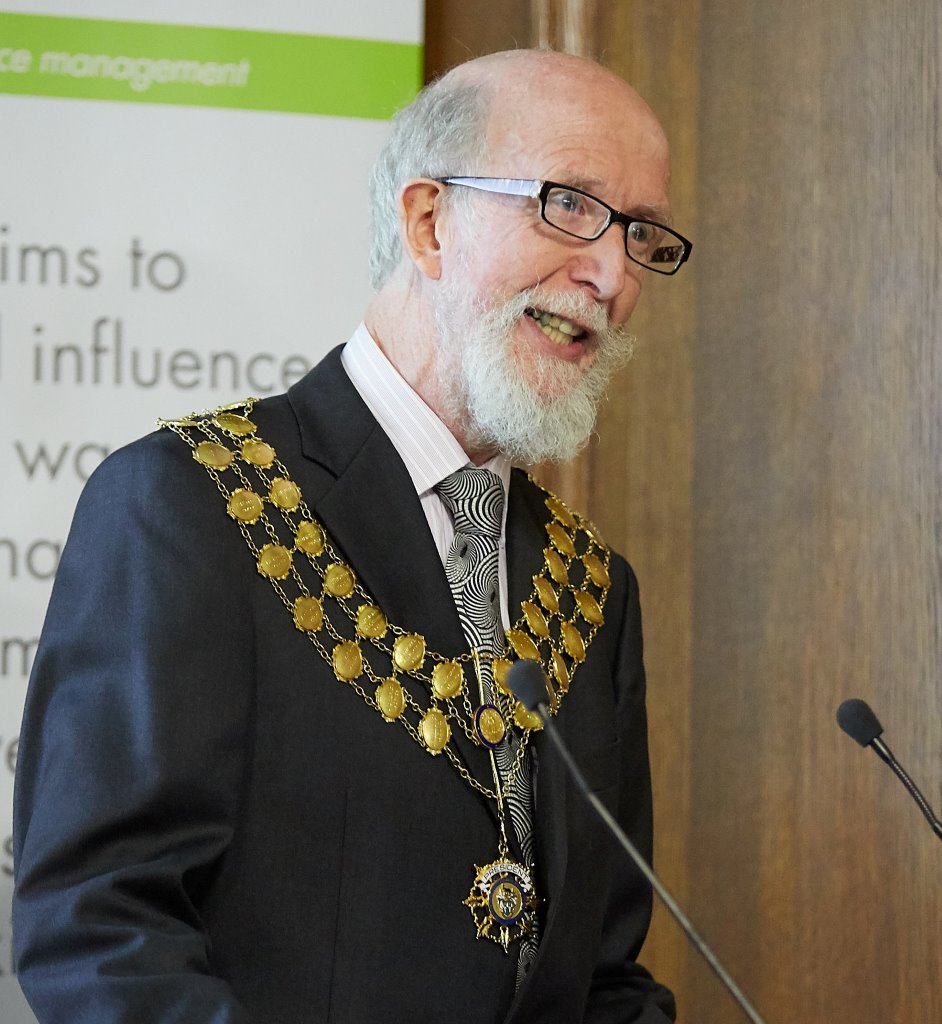
DCW inaugurated as CIWM President
Professor David C Wilson giving his inauguration speech as CIWM President 2017 at Church House Westminster in October 2017. His theme for the year was solid waste management as the forgotten utility service, underpinning modern society.

DCW’s CIWM Presidential Report 2017
DCW commissioned WasteAid UK to prepare a practical toolkit for poor communities on how to make useful products from the low-value plastics and organics in their waste. In its first year, the website was visited 56,000 times, with 7,000 downloads of the toolkit.
ISWA Publication Award 2015
DCW with co-authors Ljiljana Rodic, Andy Whiteman, Costas Velis, Barbara Oelz, Joachim Stretz and Anne Scheinberg, receiving the Award from ISWA Scientific and Technical Committee Chair Antonis Mavropoulos (left), at the ISWA 2015 World Congress in Antwerp on Tuesday 08 September.