4 December, 2025 | Waste Management
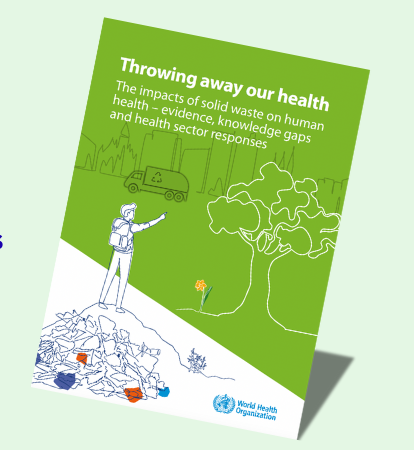
WHO is launching a new global report, “Throwing away our health: The impacts of solid waste on human health.” Join the launch webinar on 16 Dec 2025, 13:00–14:00 UTC / GMT. DCW was pleased to advise on and review this important report and will join the panel discussion at the launch.
Formal municipal solid waste (MSW) management services were introduced in 19th century cities to protect public health. This report is a timely reminder of the continuing importance of that role, drawing attention in particular to the continuing public health risks where municipal solid wastes are not collected (UNEP/ISWA GWMO: 2.7 billion people without waste collection) and/or when they are open dumped or burned (~40% of global MSW collected). The report brings together current knowledge on how solid waste can impact health in both the global south and the global north; where the evidence is still missing; and what the health sector can do to drive change.
3 December, 2025 | Waste Management
DCW was pleased to co-author two papers on a system-wide assessment of Indonesia’s plastic value chain. One, mapping external stakeholders, was published this week in the journal Environment Systems and Decisions. The other mapped both plastic and monetary flows and stakeholders dynamics, and was published in July in the high impact Journal of Cleaner Production. A third part of the trilogy was published in the Journal of Circular Economy in April 2025. All three papers demonstrate the innovative use of the structured systems-based framework provided by CVORR (Complex Value Optimisation for Resource Recovery), for the earlier development of which I chaired the Steering Committee. I also sat on the Advisory board of PISCES, a collaborative research project on preventing plastics pollution in Indonesia, from which these papers are outputs.
I am grateful to the two lead authors Eleni Iacovidou and Spyridoula Gerasimidou; and to my fellow co-authors Professor Susan Jobling; Eddy Setiadi Soedjono; Jessika Luth Richter; Mike Webster; Andre Kuncoroyekti; and Elena Lovat.
2 December, 2024 | Environmental legislation, Waste Management
I am shocked that the 50th anniversary of the first environment control legislation in the 1970s, and specifically the UK’s Control of Pollution Act 1974 (CoPA) has received so little attention and celebration. So I have written a Comment piece on CoPA’s Golden Jubilee for resource.co, one of the leading online news sites read by (UK) waste and resource management professionals.
The waste and resource sector as we know it only exists due to strong and effectively enforced legislation to create a ‘level playing field’, which in principle should enable investment without fear of being undercut by lower standard facilities or indeed by waste criminals. Prior to legislation in the 1970s, the norm for collected wastes was disposal in uncontrolled or partially controlled ‘landfills’ which were often permanently on fire. As I have documented in my recent magnum opus, we have come a long way in 50 years, but we also still have a long way to go. That was illustrated starkly by the announcement in November 2024 of the closure of a UK state-of-the-art plastics recycling facility after just two years.
20 November, 2024 | Waste Management
I have been writing articles and blogs for nearly 10 years to challenge the common misperception that waste and resource management contributes minimally to mitigation of climate heating. At long last, my peer-reviewed paper with ISWA co-authors collating the evidence has now been published open-access. We show that one can have HIGH CONFIDENCE that the sector’s potential is SIGNIFICANT. The paper provides a Call to Action to enable this global opportunity to be realised.
An earlier version of the paper featured at the first ever Waste and Resources pavilion, hosted by ISWA at COP28 in Egypt. This year in Baku, waste and resource management featured for the first time on the main COP29 agenda, with a Declaration On Reducing Methane from Organic Waste endorsed so far by 52 countries. The declaration has 8 objectives, which go beyond a narrow, waste sector focus on mitigating methane from landfill, to include also food waste reduction and separation of organic wastes at source for valorisation and recycling back to the soil.
The declaration highlights five enabling areas for waste sector transformation, calling for all countries to include reducing methane from organic waste in their climate mitigation plans at both national level (Nationally Determined Contributions – NDCs) and in regional and local implementation plans; stepping up finance; data for action and transparency; and innovative partnerships.
It is pleasing that this is already reflected in the Call to Action in our paper. The paper would never have been completed without the help and support of my co-authors, so heartfelt thanks to Johannes Paul, and to ISWA Technical Director Aditi Ramola and President Carlos RV Silva Filho.
Full reference: Wilson, D.C., Paul, J., Ramola, A., & Silva Filho, C. (2024). Unlocking the significant worldwide potential of better waste and resource management for climate mitigation: with particular focus on the Global South. Waste Management & Research, 42(10), 860-872.
22 October, 2024 | Waste Management
To tackle the on-going global waste emergency, with billions of people around the world still lacking basic services for solid waste collection and controlled recovery and disposal, it is important to know how much international development assistance, or Official Development Finance (ODF), has been directed to this issue. Our paper analysing two decades of data has now been published: the results are frankly shocking – it’s not how much? – but rather how little?
David Lerpiniere has worked on and off for 10 years on this rigorous but pain-staking project, requiring the manual assessment of some 10,000 project records to extract data on the SWM component. The results show that, yes, the $ amounts and the % share have increased over 20 years, but at 0.4% of the total is still an order of magnitude below the average 3% over the period 2015-2030 called for in UNEP and ISWA’s first Global Waste Management Outlook (GWMO) to extend collection services and controlled recovery and disposal to 95% of the world’s population, i.e. to meet SDG indictor 11.6.1. To add insult to injury, funding has mainly gone to relatively more developed countries middle-income countries, with just 8% of the limited SWM pot going to the low-income countries who need it the most. This paper provides the peer-reviewed evidence: now is the time for ACTION.
Full reference: Lerpiniere, D.J., Wilson, D.C., & Velis, C.A. (2025). Official development finance in solid waste management reveals insufficient resources for tackling plastic pollution: A global analysis of two decades of data. Resources, Conservation and Recycling, 212, 107918.
26 September, 2024 | Waste Management
My 2024 ISWA Publication Award for my ‘magnum opus’ was presented this week at the Gala Dinner at ISWA 2024 World Congress in Capetown. My thanks to Costas Velis for collecting the award on my behalf. The paper documents the evolution of waste and resource management over the last 50 years from my personal perspective as an involved witness, and uses that to reflect on current and future priorities.
In their citation ISWA say: ‘David emphasises the need for understanding and learning from the (past) to achieve improved (waste and resource) management around the world. The paper zooms in on three policy priorities that are critical globally: access to sustainable financing, rethinking sustainable recycling and worldwide extended producer responsibility. (In the Global South this) require(s) a people-centred approach, working with communities to provide both quality services and decent livelihoods for collection and recycling workers.’
The paper could not have been written without the work and support of the countless colleagues I have worked with over my now 50 year career – my warm thanks to you all! I have been motivated in writing this to ‘pass on the baton’ to the next generations – so please do follow ISWA’s endorsement and dip into the open access paper – I hope it gives you some inspiration.
As well as the full paper, I published a ‘taster’ version in March 2024 in the ISWA magazine Waste Management World. I struggled to squeeze 50 years of evolution since the first environmental controls over solid waste management were introduced in the 1970s, and reflections on priorities for the next decade(s), into my 50,000 word (but very accessible and readable!) contemporary witness magnum opus. I had to write a 200 word abstract, but it took me a while to prepare this short (2,500 word) ‘taster’ version. My basic thesis is that policy makers, practitioners and academics need to understand where waste and resource management has come from to plan confidently to meet future challenges and to avoid ‘reinventing the wheel’. So please have a read, pass it on to colleagues and dip into the full paper!
The title of the full paper is: Learning from the past to plan for the future. An historical review of the evolution of waste and resources management 1970-2020 and reflections on priorities 2020-2030 – The perspective of an involved witness.
