4 December, 2025 | Waste Management
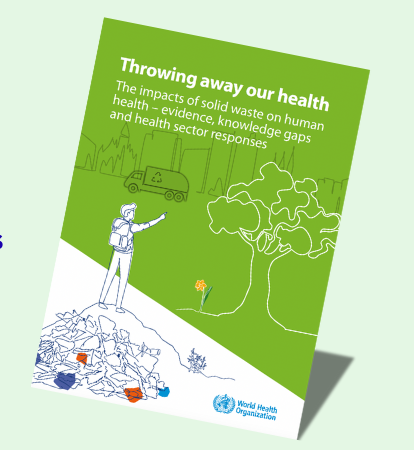
WHO is launching a new global report, “Throwing away our health: The impacts of solid waste on human health.” Join the launch webinar on 16 Dec 2025, 13:00–14:00 UTC / GMT. DCW was pleased to advise on and review this important report and will join the panel discussion at the launch.
Formal municipal solid waste (MSW) management services were introduced in 19th century cities to protect public health. This report is a timely reminder of the continuing importance of that role, drawing attention in particular to the continuing public health risks where municipal solid wastes are not collected (UNEP/ISWA GWMO: 2.7 billion people without waste collection) and/or when they are open dumped or burned (~40% of global MSW collected). The report brings together current knowledge on how solid waste can impact health in both the global south and the global north; where the evidence is still missing; and what the health sector can do to drive change.
3 December, 2025 | Waste Management
DCW was pleased to co-author two papers on a system-wide assessment of Indonesia’s plastic value chain. One, mapping external stakeholders, was published this week in the journal Environment Systems and Decisions. The other mapped both plastic and monetary flows and stakeholders dynamics, and was published in July in the high impact Journal of Cleaner Production. A third part of the trilogy was published in the Journal of Circular Economy in April 2025. All three papers demonstrate the innovative use of the structured systems-based framework provided by CVORR (Complex Value Optimisation for Resource Recovery), for the earlier development of which I chaired the Steering Committee. I also sat on the Advisory board of PISCES, a collaborative research project on preventing plastics pollution in Indonesia, from which these papers are outputs.
I am grateful to the two lead authors Eleni Iacovidou and Spyridoula Gerasimidou; and to my fellow co-authors Professor Susan Jobling; Eddy Setiadi Soedjono; Jessika Luth Richter; Mike Webster; Andre Kuncoroyekti; and Elena Lovat.
1 October, 2025 | Publication, Waste and resource management
DCW was delighted to write the Introduction to October’s editorial in the ISWA peer-reviewed journal Waste Management & Research (WM&R), where Mike Webster gives his personal reflections from five years of working to extend waste collection services to previously underserved communities in Indonesia. The world is struggling to deal with the global waste emergency of more than 2.7 billion people worldwide lacking access to the basic service of municipal solid waste collection. Mike’s reflections offer a ‘breath of fresh air’ – using his words to summarise: let’s not forget the basics of solid waste collection and controlled disposal, let’s be clear-eyed about the challenges, and let’s get on with it…
Thank you to the Editors-in-Chief Anke Bockreis, Arne M. Ragossnig and Costas Velis for publishing the editorial this month in the Special Issue of WM&R for the ISWA2025 World Congress in Buenos Aires from October 27-29 2025.
17 March, 2025 | Publication, Waste and resource management
In DCW’s new paper with Andy Whiteman and Nicole Hennessy, published open access by the leading journal Oxford Development Studies, we spotlight the urgent need to rethink how to extend waste services to reach underserved communities. UNEP and ISWA’s GWMO2024 estimates that 2.7 billion people worldwide still lack access to solid waste collection, with at a least a billion more whose collected waste is open dumped or burned. Progress in extending services in upper middle income countries and in parts of larger cities in lower income countries has been steady, but too many unserved or underserved communities are proving hard to reach. We argue that it is time for a radical rethink of our approach to tackle this global waste emergency.
The benefits of extending services to underserved communities (i.e. reaching 95+% on both components of indicator SDG 11.6.1. i.e collection coverage and controlled disposal) are Win⁵ (i.e. win-win-win-win-win): better community services, reduced disease outbreaks, more sustainable livelihoods, reduced municipal solid waste quantities and management costs, and reduced local and global environment impacts. The costs are local but the benefits are global and local: extending services to meet SDG11.6.1 would reduce macroplastic dispersal to the environment by ~80% and significantly mitigate climate heating.
Cities can transition earlier to more circular, integrated, sustainable, waste and resource management (WaRM), through initiating governance reforms; making early no regret investments; and focusing on what money matters? No regret investments include extending collection services; supporting recovery value chains – e.g. separating (wet) organic wastes from (dry) recyclable materials at source unlocks markets for both; and upgrading existing designated disposal facilities. A blend of finance is needed, from national and city sources, resource revenues, disposal pricing, extended producer responsibility (EPR) and international development (including climate and plastics) finance). New multi-lateral impact funds are needed that target extension of services to underserved communities.
Thanks to the Oxford Development Studies editors Jo Beall and her co-editor Mansoor Ali for inviting us to contribute to the (in process) Special Issue on Integrated Sustainable (Solid) Waste Management.
2 December, 2024 | Environmental legislation, Waste Management
I am shocked that the 50th anniversary of the first environment control legislation in the 1970s, and specifically the UK’s Control of Pollution Act 1974 (CoPA) has received so little attention and celebration. So I have written a Comment piece on CoPA’s Golden Jubilee for resource.co, one of the leading online news sites read by (UK) waste and resource management professionals.
The waste and resource sector as we know it only exists due to strong and effectively enforced legislation to create a ‘level playing field’, which in principle should enable investment without fear of being undercut by lower standard facilities or indeed by waste criminals. Prior to legislation in the 1970s, the norm for collected wastes was disposal in uncontrolled or partially controlled ‘landfills’ which were often permanently on fire. As I have documented in my recent magnum opus, we have come a long way in 50 years, but we also still have a long way to go. That was illustrated starkly by the announcement in November 2024 of the closure of a UK state-of-the-art plastics recycling facility after just two years.
