4 December, 2025 | Waste Management
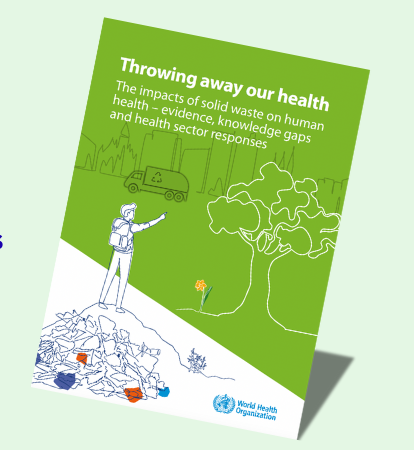
WHO is launching a new global report, “Throwing away our health: The impacts of solid waste on human health.” Join the launch webinar on 16 Dec 2025, 13:00–14:00 UTC / GMT. DCW was pleased to advise on and review this important report and will join the panel discussion at the launch.
Formal municipal solid waste (MSW) management services were introduced in 19th century cities to protect public health. This report is a timely reminder of the continuing importance of that role, drawing attention in particular to the continuing public health risks where municipal solid wastes are not collected (UNEP/ISWA GWMO: 2.7 billion people without waste collection) and/or when they are open dumped or burned (~40% of global MSW collected). The report brings together current knowledge on how solid waste can impact health in both the global south and the global north; where the evidence is still missing; and what the health sector can do to drive change.
17 March, 2025 | Publication, Waste and resource management
In DCW’s new paper with Andy Whiteman and Nicole Hennessy, published open access by the leading journal Oxford Development Studies, we spotlight the urgent need to rethink how to extend waste services to reach underserved communities. UNEP and ISWA’s GWMO2024 estimates that 2.7 billion people worldwide still lack access to solid waste collection, with at a least a billion more whose collected waste is open dumped or burned. Progress in extending services in upper middle income countries and in parts of larger cities in lower income countries has been steady, but too many unserved or underserved communities are proving hard to reach. We argue that it is time for a radical rethink of our approach to tackle this global waste emergency.
The benefits of extending services to underserved communities (i.e. reaching 95+% on both components of indicator SDG 11.6.1. i.e collection coverage and controlled disposal) are Win⁵ (i.e. win-win-win-win-win): better community services, reduced disease outbreaks, more sustainable livelihoods, reduced municipal solid waste quantities and management costs, and reduced local and global environment impacts. The costs are local but the benefits are global and local: extending services to meet SDG11.6.1 would reduce macroplastic dispersal to the environment by ~80% and significantly mitigate climate heating.
Cities can transition earlier to more circular, integrated, sustainable, waste and resource management (WaRM), through initiating governance reforms; making early no regret investments; and focusing on what money matters? No regret investments include extending collection services; supporting recovery value chains – e.g. separating (wet) organic wastes from (dry) recyclable materials at source unlocks markets for both; and upgrading existing designated disposal facilities. A blend of finance is needed, from national and city sources, resource revenues, disposal pricing, extended producer responsibility (EPR) and international development (including climate and plastics) finance). New multi-lateral impact funds are needed that target extension of services to underserved communities.
Thanks to the Oxford Development Studies editors Jo Beall and her co-editor Mansoor Ali for inviting us to contribute to the (in process) Special Issue on Integrated Sustainable (Solid) Waste Management.
22 October, 2024 | Waste Management
To tackle the on-going global waste emergency, with billions of people around the world still lacking basic services for solid waste collection and controlled recovery and disposal, it is important to know how much international development assistance, or Official Development Finance (ODF), has been directed to this issue. Our paper analysing two decades of data has now been published: the results are frankly shocking – it’s not how much? – but rather how little?
David Lerpiniere has worked on and off for 10 years on this rigorous but pain-staking project, requiring the manual assessment of some 10,000 project records to extract data on the SWM component. The results show that, yes, the $ amounts and the % share have increased over 20 years, but at 0.4% of the total is still an order of magnitude below the average 3% over the period 2015-2030 called for in UNEP and ISWA’s first Global Waste Management Outlook (GWMO) to extend collection services and controlled recovery and disposal to 95% of the world’s population, i.e. to meet SDG indictor 11.6.1. To add insult to injury, funding has mainly gone to relatively more developed countries middle-income countries, with just 8% of the limited SWM pot going to the low-income countries who need it the most. This paper provides the peer-reviewed evidence: now is the time for ACTION.
Full reference: Lerpiniere, D.J., Wilson, D.C., & Velis, C.A. (2025). Official development finance in solid waste management reveals insufficient resources for tackling plastic pollution: A global analysis of two decades of data. Resources, Conservation and Recycling, 212, 107918.

1 March, 2024 | Publication, Resource and waste management
As lead author of UNEP and ISWA’s original Global Waste Management Outlook (GWMO) in 2015, and a contributing author to the long-awaited follow-up, I am thrilled to welcome the publication at UNEA-6 this week of GWMO 2024: Beyond an age of waste – Turning rubbish into a resource. Warm congratulations to the lead author, Zoë Lenkiewicz, who has written a concise and engaging report which will hopefully succeed in placing municipal solid waste management firmly where it belongs on the local and international political agenda.
Zoe has summed it up brilliantly in the 300 character summary on the back cover of the easy-to-skim-read 80-page report: ‘The Global Waste Management Outlook 2024 echoes the 2015 Global Waste Management Outlook’s call to action to scale up efforts to prevent waste generation; to extend adequate, safe and affordable municipal solid waste management to everyone worldwide; and to ensure that all unavoidable waste is managed safely.’ My thanks and congratulations to the patient project managers, Daniel Ternald of UNEP and Aditi Ramola of ISWA.
16 September, 2021 | Publication, Resource and waste management
Professor David C Wilson is pleased to co-author an important new publication The Nine Development Bands: A conceptual framework and global theory of waste and development. The open access paper in ISWA’s peer-reviewed journal Waste Management & Research can be downloaded freely. The ‘9 DBs’ builds on the integrated sustainable waste management (ISWM) analytical framework to help characterise waste and resources management (WaRM) systems in cities and countries. Based on over 100 years of combined experience of the authors (Andrew Whiteman, Mike Webster and DCW), the 9DBs is a powerful addition to the waste management practitioner’s toolkit, bringing depth and nuance to understanding of WaRM systems globally.
The early DBs reflect stepwise improvement towards the new
baseline of meeting the SDG 11.6.1 indicators of universal collection and
management in controlled facilities (DB5); while later DBs represent two
prevailing routes to move towards environmentally sound management (ESM) and
the 3Rs (Reduce, Reuse, Recycle). An aspirational DB Zero, a real circular
economy, sits above all 9 DBs, accessible via multiple pathways, posing an
ultimate challenge for development practice. The 9DBs contextualise the
challenge of meeting the waste-related SDGs, in particular for developing
countries striving towards SDG 11.6.1 but also for all countries aspiring to a
circular economy. Whether you are a practitioner, decision-maker, service
provider, or sector activist, the 9DBs will help you to identify the key
pressure points for catalysing change, and focus your time and resources on
achieving maximum impact.
