18 October, 2017 | Publication, Waste Management
DCW’s CIWM Presidential Report 2017 prepared by WasteAid UK
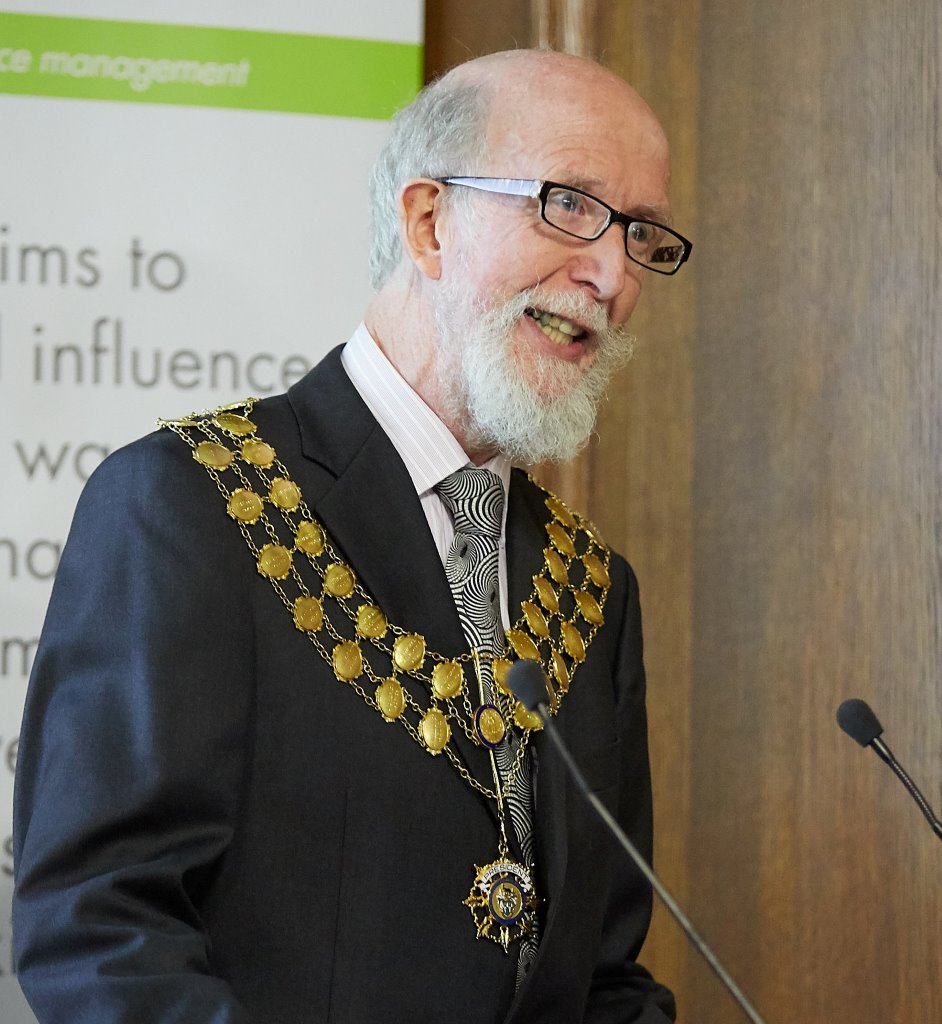
Professor David C Wilson giving his inauguration speech as CIWM President 2017-18
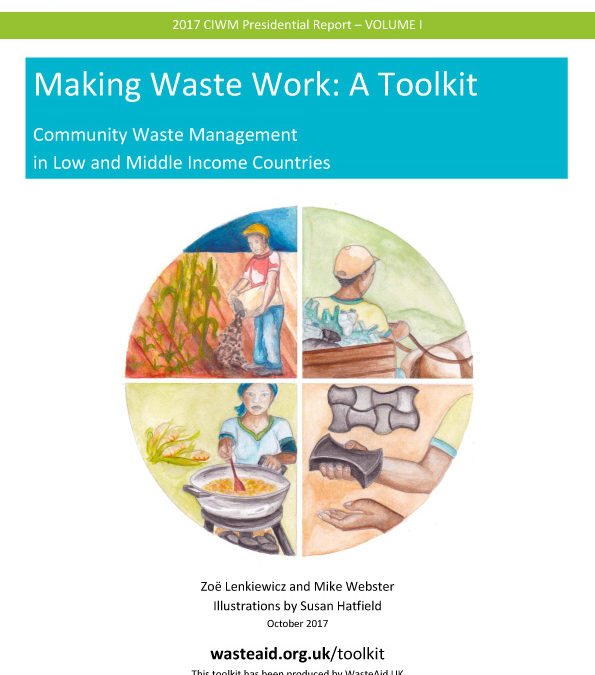
At his inauguration on 17th October 2017, Professor David C. Wilson launched his CIWM Presidential Report: Making Waste Work: A Toolkit – Community Waste Management in Low and Middle Income Countries. The aim is to help poor communities in the least developed countries, part of the 40% of the World’s population who lack access to any solid waste management services, to help themselves by developing self-sustaining businesses making useful products for the local market from the resource value in their waste. WasteAid UK have prepared this practical guidance on low cost recycling technologies, involving minimal capital investment, to help people become self-employed recycling entrepreneurs, providing a very valuable service for the health and well-being of their community, and the whole planet – as well as reducing poverty and creating sustainable livelihoods.
In his inauguration speech, DCW called on the international community to increase substantially, from the current 0/3% to 3.0%, the proportion of Official Development Assistance directed to solving the ‘global waste emergency’. But he also said that it was not enough to work with national and local governments to solve the problem from the ‘top down’. In parallel, it is necessary to work from the ‘bottom up’, helping communities in the poorest countries, where the local authority often has no funds to provide a service, to tackle the problem themselves through the resource value in the wastes. If, for example, food wastes or plastics are kept separate, they can be turned into new, useful products. One of the gaps identified by UNEP’s Global Waste Management Outlook ( GWMO – for which DCW was the lead author) was for practical guidance on low-cost ‘waste to wealth’ technologies which involve minimal capital investment and make products to sell in a local market.
Making Waste Work: A Toolkit has been developed by WasteAid UK to fill that gap, providing accessible and well-illustrated guidance designed for use by local practitioners. An early draft of the report was field tested at a pan-African workshop in The Gambia. Volume 1 covers part A, Be informed: Community waste management essentials, and part B, Be prepared: How do I make a waste project happen? Volume 2 covers part C, Be inspired: Step-by-step guides, which include measuring what is in your waste, five technologies for recovering value from organic wastes, four focusing on plastic wastes, plus waste collection and safe disposal of the residual wastes. There is also a short Executive Summary. The links above are to the three reports on the CIWM website; the dedicated WasteAid Toolkit homepage gives access to all the material, including the individual How-to guides, in separate user friendly formats designed for mobile devices and for laptops/ desktops.
27 August, 2017 | Conference
The German Development Bank KfW’s annual international Development Finance Forum will this year focus on the world’s oceans: Oceans 21 -Solutions for a sustainable marine future. Professor David C Wilson has been invited as the opening keynote speaker on one of the three parallel strands of the Forum, focusing on marine litter and marine plastics. The working hypothesis is that avoiding marine litter requires predominantly measures to reduce land-based sources, and of these the largest contributor by weight is inadequate solid waste management in low and middle income countries. DCW will suggest that extending waste collection to all, and eliminating open dumping of wastes, in these countries would likely reduce plastics entering the oceans by more than half. More details will follow the Forum, which is to be held in Frankfurt on 21-22 November 2017.https://corazoninc.com/cialis-cheap-20mg/
10 March, 2017 | Publication, Waste Management
Ljiljana Rodic and David C Wilson’s paper in the peer-reviewed open access journal Sustainability was published today: Resolving Governance Issues to Achieve Priority Sustainable Development Goals Related to Solid Waste Management in Developing Countries. As a key utility service that more than 2 billion people are currently lacking, solid waste management (SWM) is a crosscutting issue that can be directly linked to 12 out of the 17 UN Sustainable Development Goals (SDGs). Distinguishing between physical components and governance aspects of SWM, this research focuses on governance issues concerning basic solid waste collection services and controlled disposal, thus addressing the ‘How’ and the ‘Who’ dimensions of a SWM system.
As a form of transdisciplinary research, the findings from the literature on governance issues in SWM were iteratively subjected to several rounds of commentary by a large group of stakeholders from six continents, within the authors’ work for the United Nations Environment Programme (UNEP)’s 2015 Global Waste Management Outlook. The study identifies a combination of complementary instruments required for extending collection to all and bringing disposal under control. While municipalities have a legal responsibility for providing services to their citizens, various service providers can contribute to an effective SWM system. Appropriate forms of funding are essential to secure financial sustainability of the services under the local conditions of affordability and willingness to pay. As new services require behavioural change on the part of citizens and municipal waste departments alike, communication and exchange with other stakeholders function as enabling and supporting factors. The significance of capacity development is highlighted.
28 February, 2017 | Conference, Waste Management
Professor David C Wilson will speak at the CIWM Northern Ireland Conference and Exhibition on 29 March 2017 on: REUSE: Time to make things happen, based on a major CIWM report on the state of reuse across the five nations of the British Isles, published in October 2016. He will also make the keynote address at a Red Hot Topics Open Meeting of CIWM’s South-West Centre on April 7 2017, when his topic will be: UK waste and resource management in a global context – CIWM’s role in addressing future challenges.
22 November, 2016 | Awards, Publication, Waste Management
Professor David C Wilson was installed as Senior Vice President of the Chartered Institution of Wastes Management on 18 October 2016. CIWM has now commissioned WasteAid UK to undertake his Presidential project, which will prepare guidance on low-cost reuse and recycling technologies for use in low- and middle- income countries. This was one of the recommendations for follow-up work coming out of the 2015 UNEP Global Waste Management Outlook, for which DCW was the Editor-in-Chief.
Further information is available in a joint CIWM and Wasteaid UK press release issued today. Professor Wilson said: “More than two billion people worldwide do not have a waste collection service, which results in severe public health problems – through children playing amongst waste, blocked drains, infectious diseases and inhalation of smoke from open burning. Even when waste is collected, uncontrolled dumping is the norm – the waste of some 3 billion people isn’t disposed of safely.
“Many cities in Africa and Asia are growing so rapidly that in 15-20 years’ time they will be generating twice as much waste as they do today. Already struggling with the waste crisis, these cities desperately need targeted support from the international community. In the meantime, sustainable and self-financing community-led solutions can make immediate improvements, hence the focus of this research.”
WasteAid UK delivers training in community waste management in low- and middle-income countries. In its first year the charity has worked in the Gambia, Senegal, Ghana and Kenya, setting up community recycling facilities and positively impacting the lives of some 124,000 people.
Mike Webster of WasteAid UK said: “This guidance, funded by CIWM, will enable us to help thousands of communities around the world to improve the way they manage their waste. It will show people how to treat different materials to maximise their value and minimise risks to human health and the environment.” DCW is Patron of Wasteaid UK.