4 December, 2025 | Waste Management
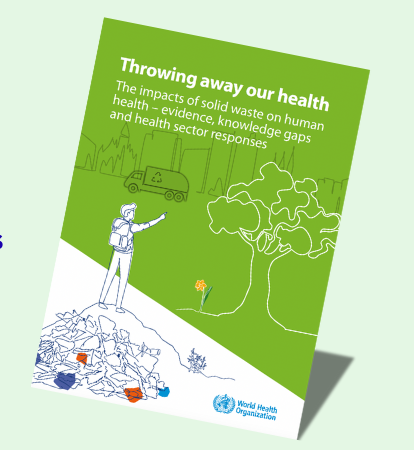
WHO is launching a new global report, “Throwing away our health: The impacts of solid waste on human health.” Join the launch webinar on 16 Dec 2025, 13:00–14:00 UTC / GMT. DCW was pleased to advise on and review this important report and will join the panel discussion at the launch.
Formal municipal solid waste (MSW) management services were introduced in 19th century cities to protect public health. This report is a timely reminder of the continuing importance of that role, drawing attention in particular to the continuing public health risks where municipal solid wastes are not collected (UNEP/ISWA GWMO: 2.7 billion people without waste collection) and/or when they are open dumped or burned (~40% of global MSW collected). The report brings together current knowledge on how solid waste can impact health in both the global south and the global north; where the evidence is still missing; and what the health sector can do to drive change.
3 December, 2025 | Waste Management
DCW was pleased to co-author two papers on a system-wide assessment of Indonesia’s plastic value chain. One, mapping external stakeholders, was published this week in the journal Environment Systems and Decisions. The other mapped both plastic and monetary flows and stakeholders dynamics, and was published in July in the high impact Journal of Cleaner Production. A third part of the trilogy was published in the Journal of Circular Economy in April 2025. All three papers demonstrate the innovative use of the structured systems-based framework provided by CVORR (Complex Value Optimisation for Resource Recovery), for the earlier development of which I chaired the Steering Committee. I also sat on the Advisory board of PISCES, a collaborative research project on preventing plastics pollution in Indonesia, from which these papers are outputs.
I am grateful to the two lead authors Eleni Iacovidou and Spyridoula Gerasimidou; and to my fellow co-authors Professor Susan Jobling; Eddy Setiadi Soedjono; Jessika Luth Richter; Mike Webster; Andre Kuncoroyekti; and Elena Lovat.
17 March, 2025 | Publication, Waste and resource management
In DCW’s new paper with Andy Whiteman and Nicole Hennessy, published open access by the leading journal Oxford Development Studies, we spotlight the urgent need to rethink how to extend waste services to reach underserved communities. UNEP and ISWA’s GWMO2024 estimates that 2.7 billion people worldwide still lack access to solid waste collection, with at a least a billion more whose collected waste is open dumped or burned. Progress in extending services in upper middle income countries and in parts of larger cities in lower income countries has been steady, but too many unserved or underserved communities are proving hard to reach. We argue that it is time for a radical rethink of our approach to tackle this global waste emergency.
The benefits of extending services to underserved communities (i.e. reaching 95+% on both components of indicator SDG 11.6.1. i.e collection coverage and controlled disposal) are Win⁵ (i.e. win-win-win-win-win): better community services, reduced disease outbreaks, more sustainable livelihoods, reduced municipal solid waste quantities and management costs, and reduced local and global environment impacts. The costs are local but the benefits are global and local: extending services to meet SDG11.6.1 would reduce macroplastic dispersal to the environment by ~80% and significantly mitigate climate heating.
Cities can transition earlier to more circular, integrated, sustainable, waste and resource management (WaRM), through initiating governance reforms; making early no regret investments; and focusing on what money matters? No regret investments include extending collection services; supporting recovery value chains – e.g. separating (wet) organic wastes from (dry) recyclable materials at source unlocks markets for both; and upgrading existing designated disposal facilities. A blend of finance is needed, from national and city sources, resource revenues, disposal pricing, extended producer responsibility (EPR) and international development (including climate and plastics) finance). New multi-lateral impact funds are needed that target extension of services to underserved communities.
Thanks to the Oxford Development Studies editors Jo Beall and her co-editor Mansoor Ali for inviting us to contribute to the (in process) Special Issue on Integrated Sustainable (Solid) Waste Management.
28 January, 2019 | Publication, Resource and waste management
Professor David C Wilson has been working for the last two years with the Rwandan academic Telesphore Kabera to apply the Wasteaware indicators to benchmark performance of the solid waste management (SWM) and recycling system in Kigali, the capital of Rwanda. Their results form the basis of a paper published today in the first ever open access issue of the long established ISWA peer-reviewed journal Waste Management & Research. The paper uses previously unpublished results from the Wasteaware database to compare Kigali’s performance with four other East African capital cities – Dar-es-Salaam, Kampala, Nairobi and Maputo.
http://worklife.wharton.upenn.edu/sildenafil-online/
The Wasteaware benchmark indicators grew out of work originally carried out for UN-Habitat’s Soild Waste Management in the World’s Cities (2010). They provide a standardised method to characterise the performance of a city’s SWM and recycling system across some 15 indicators, some quantitative and some qualitative, covering both waste generation, the physical aspects of waste and resource management, and various governance aspects. Results for the first 40 cities were used extensively in UNEP and ISWA’s inaugural Global Waste Management Outlook (2015). They are now being applied widely, both to characterise the baseline position in a city; to identify priority areas for improvement; and to monitor progress over time.
From this paper on East Africa, the stand-out result is the relatively high collection coverage achieved in two of the cities: in Maputo with extensive international technical assistance, and in Kigali using its own local resources. In both cases, governance factors are key. Kigali uses a public-private partnership (PPP), with exclusive franchises in 35 sectors being tendered every three years; households pay an affordable fee depending on their ability to pay (the service is free to the poorest category); 95% fee collection rates are achieved, partly through co-collection with charges for local security patrols, which is a service people value highly given the recent history of the country.
Another key priority to improve solid waste management across East Africa is to eliminate open dumping – only Kampala currently has an engineered disposal site. Recycling rates also need to be increased – only Nairobi currently has a good baseline to build on (30%). Common weaknesses include a lack of segregation at source; and of institutional capacity and of available and reliable waste data.
19 December, 2018 | Publication, Resource and waste management
Professor David C. Wilson’s final contribution to the CIWM Journal took the form of an interview in which he looked back on his Presidential year. This web-posting also includes an index of and links to his monthly columns for the CIWM journal, many of which were ‘think-pieces’ on issues in which he has been involved for years or even decades. Among the questions covered in the final interview were: has any topic dominated the year (yes, plastics – both marine plastics and the ‘China ban’); and what would be your advice to Enda Kiernan and future CIWM Presidents (‘Be true to yourself’ – which the editor also used as this month’s headline).
https://www.babyscanclinic.com/blog/order-generic-levitra/
Interviews and DCW’s theme for the year:
- Dec 2018: ‘Be true to yourself’. DCW looks back on his year as president. PDF attached at end of post.
- Dec 2017: A key utility service. DCW revisited his Presidential address to further explain his key themes for the year ahead. The overarching theme was to have solid waste management recognised as an essential utility service.
- Nov 2017: One small step. The editor Ben Wood introduced DCW, his story in waste and his hopes for his Presidential year. PDF attached at end of post.
Plastics:
- Oct 2018: Plastics – diabolic or fantastic? How to respond to the crisis of plastics entering our oceans? Which plastic uses are diabolic and which fantastic?
- Jun 2018: How to influence people. DCW reported on CIWM’s role in influencing the UK’s initiative on marine plastics which was announced at the Commonwealth Heads of Government Meeting in London in April 2018.
- Apr 2018: China – coming full circle. In the wake of the current China-induced recycling crisis in the West, DCW gave his personal perspective on China’s journey in waste management and recycling over the last 30-40 years and moving forward…
- Feb 2018: Turning the tide. Where do plastics entering the ocean come from, and how do we turn the tide?
Promoting waste reduction and recycling:
- Sep 2018: Charge! DCW reflected on the challenges of devising the right policies to charge households for solid waste management services
- May 2018: Revaluing recycling. DCW argued that we need to rethink recycling if it is to become sustainable and proposed a framework for doing so, by considering the embodied social, environmental and technical values alongside the market price.
- Jan 2018: Inspiring reuse. DCW showcased the five inspiring projects shortlisted for Best Reuse or Waste Prevention Project at the CIWM Sustainability and Resource Awards 2017.
Waste and climate
- Jul 2018: Don’t waste our climate. DCW made the case for resource and waste management as an entry point to achieve significant climate mitigation. The article was subsequently re-published by the National Solid Waste Association of India (NSWAI) in their member journal Waste Monitor in July 2019.
- Website May 2018: Uncontrolled burning of solid waste as a significant contributor to climate change. DCW reported on current research at Imperial College London.
Tackling the global waste crisis
- Website Nov 2018: DCW awards his Presidential Medal to Mike Webster, Founder and CEO of the charity Wasteaid.
- Website Oct 2018: Tackling the global waste crisis through community waste management. DCW reported on two papers in the peer-reviewed literature, which follow-up on the CIWM-Waste aid toolkit Making Waste Work.
- Dec 2017: A key utility service. A key theme for DCW’s Presidential year was to highlight the global waste crisis, the 3 billion people who lack access to basic SWM services.
- Website Nov 2017: DCW launches toolkit for community waste management. Introducing DCW’s Presidential Report, the CIWM-Wasteaid Toolkit Making Waste Work. The Toolkit includes a dozen How-to-do-it Guides to enable local entrepreneurs to implement simple technologies using organics and low-value plastics in the waste.
Other DCW areas of interest or ‘hobby horses’:
- Aug 2018: Hazardous waste – plus ça change. DCW reflected on 40 years of involvement with hazardous waste policy, and concluded that the current and future challenges identified by CIWM’s Hazardous Waste Special Interest Group have changed relatively little over the years.
- Mar 2018: Let’s skip “the tip”. DCW argued that terms such as “the tip”, “rubbish”, “refuse” and arguably “tipping”, have no place in the vocabulary of the professional waste and resource manager.
