26 September, 2024 | Waste Management
My 2024 ISWA Publication Award for my ‘magnum opus’ was presented this week at the Gala Dinner at ISWA 2024 World Congress in Capetown. My thanks to Costas Velis for collecting the award on my behalf. The paper documents the evolution of waste and resource management over the last 50 years from my personal perspective as an involved witness, and uses that to reflect on current and future priorities.
In their citation ISWA say: ‘David emphasises the need for understanding and learning from the (past) to achieve improved (waste and resource) management around the world. The paper zooms in on three policy priorities that are critical globally: access to sustainable financing, rethinking sustainable recycling and worldwide extended producer responsibility. (In the Global South this) require(s) a people-centred approach, working with communities to provide both quality services and decent livelihoods for collection and recycling workers.’
The paper could not have been written without the work and support of the countless colleagues I have worked with over my now 50 year career – my warm thanks to you all! I have been motivated in writing this to ‘pass on the baton’ to the next generations – so please do follow ISWA’s endorsement and dip into the open access paper – I hope it gives you some inspiration.
As well as the full paper, I published a ‘taster’ version in March 2024 in the ISWA magazine Waste Management World. I struggled to squeeze 50 years of evolution since the first environmental controls over solid waste management were introduced in the 1970s, and reflections on priorities for the next decade(s), into my 50,000 word (but very accessible and readable!) contemporary witness magnum opus. I had to write a 200 word abstract, but it took me a while to prepare this short (2,500 word) ‘taster’ version. My basic thesis is that policy makers, practitioners and academics need to understand where waste and resource management has come from to plan confidently to meet future challenges and to avoid ‘reinventing the wheel’. So please have a read, pass it on to colleagues and dip into the full paper!
The title of the full paper is: Learning from the past to plan for the future. An historical review of the evolution of waste and resources management 1970-2020 and reflections on priorities 2020-2030 – The perspective of an involved witness.

1 March, 2024 | Publication, Resource and waste management
As lead author of UNEP and ISWA’s original Global Waste Management Outlook (GWMO) in 2015, and a contributing author to the long-awaited follow-up, I am thrilled to welcome the publication at UNEA-6 this week of GWMO 2024: Beyond an age of waste – Turning rubbish into a resource. Warm congratulations to the lead author, Zoë Lenkiewicz, who has written a concise and engaging report which will hopefully succeed in placing municipal solid waste management firmly where it belongs on the local and international political agenda.
Zoe has summed it up brilliantly in the 300 character summary on the back cover of the easy-to-skim-read 80-page report: ‘The Global Waste Management Outlook 2024 echoes the 2015 Global Waste Management Outlook’s call to action to scale up efforts to prevent waste generation; to extend adequate, safe and affordable municipal solid waste management to everyone worldwide; and to ensure that all unavoidable waste is managed safely.’ My thanks and congratulations to the patient project managers, Daniel Ternald of UNEP and Aditi Ramola of ISWA.
3 March, 2022 | Publication, Resource and waste management
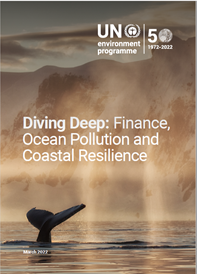
A key constraint to improving waste and resource management in many countries is a lack of access to investment finance. Extending waste collection to all and phasing out uncontrolled dumping and open burning in low-income countries would significantly cut the mass of plastics reaching the ocean. So the UNEP Finance Initiative publication Diving Deep, aimed at banks, insurers and institutional investors, is very welcome. Guidance is provided in the form of a science-based, actionable toolkit, to ensure that their investments, both in product manufacture and in waste management, encourage waste prevention and sound waste management, thus keeping plastics out of the oceans.
The promotional video and the document itself are worth looking at just for the wonderful images by world-renowned photographer Cristina Mittermeier of Sea Legacy. The guidance was prepared by WWF (led by Paula Chin) and RWA (led by Andy Whiteman). DCW played a small role as one of the reviewers.
8 November, 2021 | Climate mitigation, Waste Management
Professor David C Wilson welcomes the only waste-related official side event at COP26 which is being held in Glasgow today at 1315 and available to watch on the United Nations – Climate Change COP 26 YouTube channel. That the topic is ‘A wasted opportunity: open burning of waste causes a climate and health calamity’ is an added bonus. Congratulations to ISWA, Wasteaid, Engineering X and partners for getting both waste and open burning on the official COP26 agenda!
To ‘eliminate uncontrolled disposal and open burning of waste’ is the second of the waste-related SDGs set out in UNEP and ISWA’s inaugural Global Waste Management Outlook (2015), for which DCW was the lead author. It is one of the two indicators within SDG indicator 11.6.1, for which UN-Habitat have recently published guidance. The climate heating implications of black carbon from open burning of waste have been demonstrated by Natalia Reyna, DCW and co-authors, who estimated that it is responsible for between 2-10% of global CO₂ equivalent emissions. The serious health impacts of open burning have been highlighted in a recent report by Engineering X, who are now leading an international collaboration to support its phasing out – DCW has joined their Technical Advisory Group. Open burning is also a major campaign issue for the charities Wasteaid, of which DCW is a Patron, and Tearfund, to whom DCW has provided advice on their ‘burning issue’ report.
16 September, 2021 | Publication, Resource and waste management
Professor David C Wilson is pleased to co-author an important new publication The Nine Development Bands: A conceptual framework and global theory of waste and development. The open access paper in ISWA’s peer-reviewed journal Waste Management & Research can be downloaded freely. The ‘9 DBs’ builds on the integrated sustainable waste management (ISWM) analytical framework to help characterise waste and resources management (WaRM) systems in cities and countries. Based on over 100 years of combined experience of the authors (Andrew Whiteman, Mike Webster and DCW), the 9DBs is a powerful addition to the waste management practitioner’s toolkit, bringing depth and nuance to understanding of WaRM systems globally.
The early DBs reflect stepwise improvement towards the new
baseline of meeting the SDG 11.6.1 indicators of universal collection and
management in controlled facilities (DB5); while later DBs represent two
prevailing routes to move towards environmentally sound management (ESM) and
the 3Rs (Reduce, Reuse, Recycle). An aspirational DB Zero, a real circular
economy, sits above all 9 DBs, accessible via multiple pathways, posing an
ultimate challenge for development practice. The 9DBs contextualise the
challenge of meeting the waste-related SDGs, in particular for developing
countries striving towards SDG 11.6.1 but also for all countries aspiring to a
circular economy. Whether you are a practitioner, decision-maker, service
provider, or sector activist, the 9DBs will help you to identify the key
pressure points for catalysing change, and focus your time and resources on
achieving maximum impact.
