3 March, 2022 | Publication, Resource and waste management
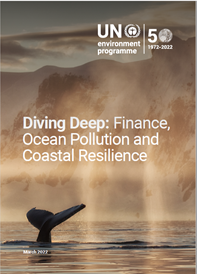
A key constraint to improving waste and resource management in many countries is a lack of access to investment finance. Extending waste collection to all and phasing out uncontrolled dumping and open burning in low-income countries would significantly cut the mass of plastics reaching the ocean. So the UNEP Finance Initiative publication Diving Deep, aimed at banks, insurers and institutional investors, is very welcome. Guidance is provided in the form of a science-based, actionable toolkit, to ensure that their investments, both in product manufacture and in waste management, encourage waste prevention and sound waste management, thus keeping plastics out of the oceans.
The promotional video and the document itself are worth looking at just for the wonderful images by world-renowned photographer Cristina Mittermeier of Sea Legacy. The guidance was prepared by WWF (led by Paula Chin) and RWA (led by Andy Whiteman). DCW played a small role as one of the reviewers.
16 September, 2021 | Publication, Resource and waste management
Professor David C Wilson is pleased to co-author an important new publication The Nine Development Bands: A conceptual framework and global theory of waste and development. The open access paper in ISWA’s peer-reviewed journal Waste Management & Research can be downloaded freely. The ‘9 DBs’ builds on the integrated sustainable waste management (ISWM) analytical framework to help characterise waste and resources management (WaRM) systems in cities and countries. Based on over 100 years of combined experience of the authors (Andrew Whiteman, Mike Webster and DCW), the 9DBs is a powerful addition to the waste management practitioner’s toolkit, bringing depth and nuance to understanding of WaRM systems globally.
The early DBs reflect stepwise improvement towards the new
baseline of meeting the SDG 11.6.1 indicators of universal collection and
management in controlled facilities (DB5); while later DBs represent two
prevailing routes to move towards environmentally sound management (ESM) and
the 3Rs (Reduce, Reuse, Recycle). An aspirational DB Zero, a real circular
economy, sits above all 9 DBs, accessible via multiple pathways, posing an
ultimate challenge for development practice. The 9DBs contextualise the
challenge of meeting the waste-related SDGs, in particular for developing
countries striving towards SDG 11.6.1 but also for all countries aspiring to a
circular economy. Whether you are a practitioner, decision-maker, service
provider, or sector activist, the 9DBs will help you to identify the key
pressure points for catalysing change, and focus your time and resources on
achieving maximum impact.
29 January, 2021 | Publication, Resource and waste management
Professor David C. Wilson has contributed a chapter on the SDGs as drivers for change to The Routledge Handbook of Waste, Resources and the Circular Economy, edited by Terry Tudor and Cleber Dutra and published on 28 December 2020. This has been a subject on which DCW has worked extensively, as re-casting improved waste and resource management as an entry point for tackling multiple, high-profile sustainable development goals significantly strengthens the case for action.
Solid waste management is not one of the high-level SDGs; like the equally important topic of air pollution, it is rather cross-cutting, impacting on multiple SDGs. DCW links five global waste targets, as defined in UNEP and ISWA’s inaugural Global Waste Management Outlook, to the 17 SDGs. He shows strong and in principle measurable links to six SDGs, not only the ‘obvious’ SDG11 (sustainable cities) & indicator 11.6.1, and SDG12 (responsible consumption and production); but also SDG1 (end poverty), SDG 6 (clean water and sanitation); and SDG13 climate action and SDG14 life below water (preventing plastics reaching the oceans). Links to six other high priority SDGs are still direct but more difficult to measure (e.g. SDG8 decent work through sustainable job creation, and SDG2 zero hunger through reducing food waste). Indirect links can also be made to the remaining five SDGs, including difficult-to-tackle equality and governance issues.
The Handbook sits behind a paywall, with only the abstract of the chapter online. The accepted manuscript of the chapter can be downloaded here:
