
News & Updates
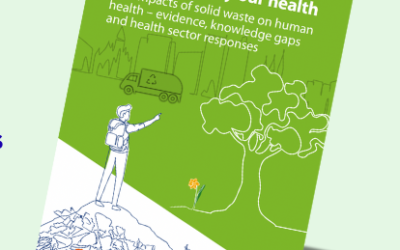
Launch of new WHO report on solid waste and health
WHO is launching a new global report, “Throwing away our health: The impacts of solid waste on human health.” Join the launch webinar on 16 Dec 2025, 13:00–14:00 UTC / GMT. DCW was pleased to advise on and review this important report and will join the panel discussion at the launch.
System-wide assessment of Indonesia’s plastic value chain
DCW was pleased to co-author two papers on a system-wide assessment of Indonesia’s plastic value chain. One, mapping external stakeholders, was published this week in the journal Environment Systems and Decisions. The other mapped both plastic and monetary flows and stakeholders dynamics, and was published in July in the high impact Journal of Cleaner Production. Both papers demonstrate the innovative use of the structured systems-based framework provided by CVORR (Complex Value Optimisation for Resource Recovery), for the earlier development of which DCW chaired the Steering Committee.
Forget everything you thought you knew: 10 insights from the frontline of extending waste management services
DCW was delighted to write the Introduction to October’s editorial in the ISWA peer-reviewed journal Waste Management & Research (WM&R), where Mike Webster gives his personal reflections from five years of working to extend waste collection services to previously underserved communities in Indonesia. The world is struggling to deal with the global waste emergency of more than 2.7 billion people worldwide lacking access to the basic service of municipal solid waste collection. Mike’s reflections offer a ‘breath of fresh air’.
We have a new Science-Policy Panel on Chemicals, Waste and Pollution!
After several years of fraught negotiations, 98 Member States of the UN agreed on 20 June 2025 to set up a new Intergovernmental Science-Policy Panel on Chemicals, Waste and Pollution. The official acronym is ISP-CWP, to sit alongside the existing Intergovernmental...
Rethinking waste and resource management for underserved communities
In DCW’s new paper with Andy Whiteman and Nicole Hennessy, published open access by the leading journal Oxford Development Studies, we spotlight the urgent need to rethink how to extend waste services to reach underserved communities. UNEP and ISWA’s GWMO2024 estimates that 2.7 billion people worldwide still lack access to solid waste collection, with at a least a billion more whose collected waste is open dumped or burned. Progress in extending services in upper middle income countries and in parts of larger cities in lower income countries has been steady, but too many unserved or underserved communities are proving hard to reach. We argue that it is time for a radical rethink of our approach to tackle this global waste emergency.
Marking 50 years since the first Control of Pollution Act 1974
I am shocked that the 50th anniversary of the first environment control legislation in the 1970s, and specifically the UK’s Control of Pollution Act 1974 (CoPA) has received so little attention and celebration. So I have written a Comment piece on CoPA’s Golden Jubilee for resource.co, one of the leading online news sites read by (UK) waste and resource management professionals.
Waste and resource management on COP29 agenda as a priority climate issue
I have been writing articles and blogs for nearly 10 years to challenge the common misperception that waste and resource management contributes minimally to mitigation of climate heating. At long last, my peer-reviewed paper with ISWA co-authors collating the evidence has now been published open-access. We show that one can have HIGH CONFIDENCE that the sector’s potential is SIGNIFICANT. The paper provides a Call to Action to enable this global opportunity to be realised.
How little Official Development Finance goes to solid waste management?
To tackle the on-going global waste emergency, with billions of people around the world still lacking basic services for solid waste collection and controlled recovery and disposal, it is important to know how much international development assistance, or Official Development Finance (ODF), has been directed to this issue. Our paper analysing two decades of data has now been published: the results are frankly shocking – it’s not how much? – but rather how little?
DCW’s magnum opus wins ISWA Publication Award 2024
My 2024 ISWA Publication Award for my ‘magnum opus’ was presented this week at the Gala Dinner at ISWA 2024 World Congress in Capetown. My thanks to Costas Velis for collecting the award on my behalf. The paper documents the evolution of waste and resource management...
Proper Waste Management in the Plastics Treaty
I am very pleased to collaborate with Tearfund to reframe the discussion around waste management in the Plastics Treaty negotiations. The Plastics Treaty is once-in-a-generation opportunity to end Plastic Pollution. We absolutely need to ‘turn off the tap’ by upstream...

GWMO2 now published!
As lead author of UNEP and ISWA’s original Global Waste Management Outlook (GWMO) in 2015, and a contributing author to the long-awaited follow-up, I am thrilled to welcome the publication at UNEA-6 this week of GWMO 2024: Beyond an age of waste – Turning rubbish into a resource. Warm congratulations to the lead author, Zoë Lenkiewicz, who has written a concise and engaging report which will hopefully succeed in placing municipal solid waste management firmly where it belongs on the local and international political agenda.
Learning from the past to plan for the future
My magnum opus that I’ve been working for the last 5 years has now been published. This uses my own experiences and analytical tools to review the historical evolution of waste and resource management since the first environmental legislation back in the 1970s when I first started working as a consultant in the sector. I then draw on my more recent international policy work to reflect on priorities and challenges over the next decade. My basic thesis is that we need to understand how the sector has evolved in the recent past to plan confidently for the future. I hope it will be widely read, not least to avoid ‘reinventing the wheel’; which is why I have published open access, as part of the 40th anniversary celebrations of ISWA’s peer-reviewed journal Waste Management & Research, rather than as a shiny book sitting behind a paywall.
The significant potential of better waste and resource management for climate mitigation
ISWA are hosting the first ever Waste and Resources Pavilion at COP28 in Dubai. My contribution is an article, co-authored with the ISWA President Carlos Silva Filho and Technical Director Aditi Ramola, where we challenge the common perception that waste and resource management contributes minimally to mitigation of climate heating.
Waste management needs to be central to the plastics treaty
ISWA has published my blog that makes the evidence-based case for bringing waste management onto the main agenda of the Intergovernmental Negotiating Committee (INC) for the proposed international treaty to end plastics pollution; the third INC meeting is in Nairobi 13-17 November 2023. Much of the focus of negotiations is rightly on plastics reduction and circularity. But a necessary parallel component is sound waste management and plastics leakage prevention. It is not a case of one or the other – both are necessary and complementary.
Socio-economic development drives solid waste management performance in cities
Our new open access paper tests and confirms for the first time the long-standing hypothesis that both the rate of municipal solid waste (MSW) generation in a city, and the performance of its MSW management system, depends on its level of socio-economic development...
DCW wins the 2022 ISWA Publication Award
It is indeed nice to have your work recognised! My co-authors Andy Whiteman and Mike Webster will receive the 2022 ISWA Publication Award this week at the ISWA World Congress Gala Dinner in Singapore, for our conceptual framework and global theory of waste and development, The Nine Development Bands. The 9DBs was published open access last year and is a powerful addition to the practitioner’s toolkit, bringing depth and nuance to understanding waste and resource management systems globally and helping you to focus your time and resources on achieving maximum impact. I am proud of all five of my ISWA Publication Awards over the last 20 years!
The untapped potential for better waste and resource management to curb global heating
I am pleased that the RICS Land Journal has published online an updated version of my article on the untapped potential for the waste and resource management sector to act as an enabler to unlock significant climate mitigation benefits across the economy. My best estimate of the mitigation potential is at least 15-20% of global carbon dioxide (equivalent) emissions, which is far beyond the IPCC’s estimate of 3% for the narrowly defined end-of-the linear-economy ‘waste’ sector, which is necessarily used in official climate reporting to avoid double counting.
Diving Deep: deploying finance to prevent plastic pollution of the oceans
A key constraint to improving waste and resource management in many countries is a lack of access to investment finance. Extending waste collection to all and phasing out uncontrolled dumping and open burning in low-income countries would significantly cut the mass of plastics reaching the ocean. So the UNEP Finance Initiative publication Diving Deep, aimed at banks, insurers and institutional investors, is very welcome. Guidance is provided in the form of a science-based, actionable toolkit, to ensure that their investments, both in product manufacture and in waste management, encourage waste prevention and sound waste management, thus keeping plastics out of the oceans.