3 December, 2025 | Waste Management
DCW was pleased to co-author two papers on a system-wide assessment of Indonesia’s plastic value chain. One, mapping external stakeholders, was published this week in the journal Environment Systems and Decisions. The other mapped both plastic and monetary flows and stakeholders dynamics, and was published in July in the high impact Journal of Cleaner Production. A third part of the trilogy was published in the Journal of Circular Economy in April 2025. All three papers demonstrate the innovative use of the structured systems-based framework provided by CVORR (Complex Value Optimisation for Resource Recovery), for the earlier development of which I chaired the Steering Committee. I also sat on the Advisory board of PISCES, a collaborative research project on preventing plastics pollution in Indonesia, from which these papers are outputs.
I am grateful to the two lead authors Eleni Iacovidou and Spyridoula Gerasimidou; and to my fellow co-authors Professor Susan Jobling; Eddy Setiadi Soedjono; Jessika Luth Richter; Mike Webster; Andre Kuncoroyekti; and Elena Lovat.
1 October, 2025 | Publication, Waste and resource management
DCW was delighted to write the Introduction to October’s editorial in the ISWA peer-reviewed journal Waste Management & Research (WM&R), where Mike Webster gives his personal reflections from five years of working to extend waste collection services to previously underserved communities in Indonesia. The world is struggling to deal with the global waste emergency of more than 2.7 billion people worldwide lacking access to the basic service of municipal solid waste collection. Mike’s reflections offer a ‘breath of fresh air’ – using his words to summarise: let’s not forget the basics of solid waste collection and controlled disposal, let’s be clear-eyed about the challenges, and let’s get on with it…
Thank you to the Editors-in-Chief Anke Bockreis, Arne M. Ragossnig and Costas Velis for publishing the editorial this month in the Special Issue of WM&R for the ISWA2025 World Congress in Buenos Aires from October 27-29 2025.
24 June, 2025 | Environmental legislation, Waste and resource management
After several years of fraught negotiations, 98 Member States of the UN agreed on 20 June 2025 to set up a new Intergovernmental Science-Policy Panel on Chemicals, Waste and Pollution. The official acronym is ISP-CWP, to sit alongside the existing Intergovernmental Science-Policy Panels on climate heating IPCC and biodiversity IPBES. This is excellent news, but much of the detail was left to the first plenary session, now set for 2-6 February 2026. Much further work is needed, both to ensure that the new Panel has teeth, and that waste is a core part of its ongoing programme.
27 March, 2024 | Publication, Resource and waste management, Waste Management
I am very pleased to collaborate with Tearfund to reframe the discussion around waste management in the Plastics Treaty negotiations. The Plastics Treaty is once-in-a-generation opportunity to end Plastic Pollution. We absolutely need to ‘turn off the tap’ by upstream actions to reduce plastic production, but we also need to ‘stop the bath-tub overflowing’ through proper waste management.
This is not a ‘cop out’ for the plastics producers – they are responsible for the high plastics content in municipal solid waste in lower income countries, which cannot afford proper management; so it is their responsibility to ensure that their wastes are collected and recycled properly and to pay all of the associated costs. The scientific part of the Tearfund report shows that extending municipal solid waste collection and controlled recovery and disposal to services to all (95% on SDG indicator 11.6.1) would not only address a major public health and environmental crisis impacting billions worldwide, but also reduce macroplastics dispersal to the environment (and thus available for onward transport to the ocean) by 77% and open burning by 90% . So, let’s make sure that is done!
UPDATE. The report puts forward a fit-for-purpose text on waste management for negotiators. The initial report was issued prior to the negotiation meeting INC-4 in Ottawa from 23-29 April 2024. A second edition was issued in September, to provide specific inputs to the final text negotiations which should have been concluded at INC-5 in Busan 25 November – 1 December 2024.
UPDATE. The modelling for this report by Costas Velis, Ed Cook and Josh Cottam of the University of Leeds used their SPOT model. Their seminal paper showing that uncollected municipal solid waste accounts for 85% of uncontrolled macroplastic dispersal to the environment was published in Nature in September 2024.
3 March, 2022 | Publication, Resource and waste management
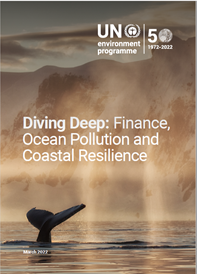
A key constraint to improving waste and resource management in many countries is a lack of access to investment finance. Extending waste collection to all and phasing out uncontrolled dumping and open burning in low-income countries would significantly cut the mass of plastics reaching the ocean. So the UNEP Finance Initiative publication Diving Deep, aimed at banks, insurers and institutional investors, is very welcome. Guidance is provided in the form of a science-based, actionable toolkit, to ensure that their investments, both in product manufacture and in waste management, encourage waste prevention and sound waste management, thus keeping plastics out of the oceans.
The promotional video and the document itself are worth looking at just for the wonderful images by world-renowned photographer Cristina Mittermeier of Sea Legacy. The guidance was prepared by WWF (led by Paula Chin) and RWA (led by Andy Whiteman). DCW played a small role as one of the reviewers.
